
Published: 15 June 2026 | Last verified: 12 September 2026
The primary South Sudan eVisa port of entry is Juba International Airport (JUB), alongside designated land borders like Nimule and Kaya. UK citizens must present a printed eVisa PDF and a passport with two blank pages. Validation at the visa counter typically takes just five minutes.
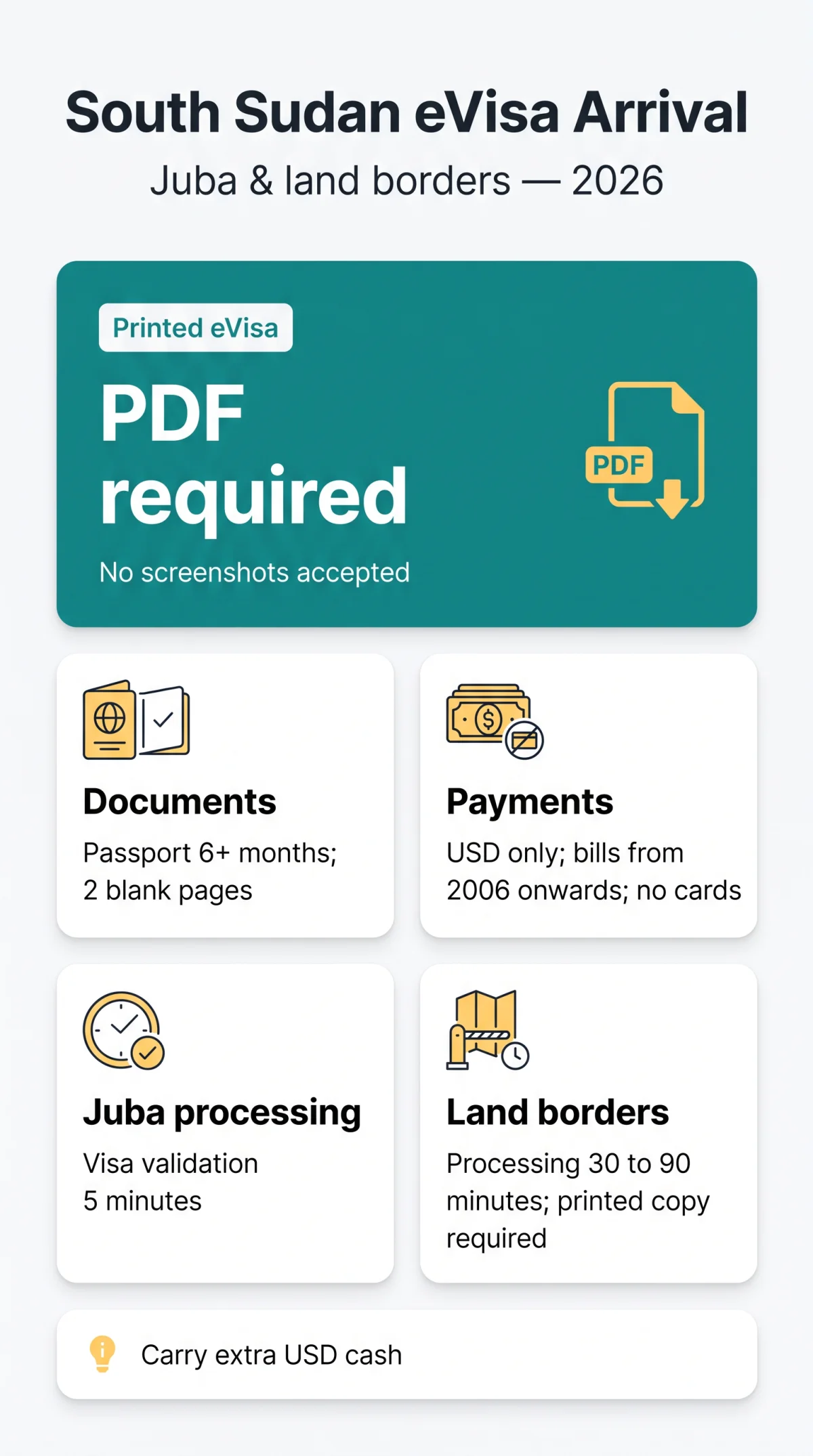
At Juba Airport, the visa counter validates printed eVisa PDFs in 5 minutes; biometrics (fingerprints and facial scan) and yellow fever certificate checks follow. Only US Dollar cash (bills from 2006 onwards, clean and untorn) is accepted at all border points; no credit or debit cards.
Approved Ports of Entry & Land Border Crossings (2026)
The South Sudan eVisa port of entry network includes Juba International Airport (JUB), Wau, Malakal, and land borders like Nimule and Kaya. Every arriving traveller must present a printed PDF. Attempting to use unapproved crossings will lead to immediate entry denial.
| Port Name | Type | Location / Border |
|---|---|---|
| Juba International Airport (JUB) | Airport | Juba |
| Wau | Airport | Wau |
| Malakal | Airport | Malakal |
| Nimule | Land Border | Uganda border |
| Kaya | Land Border | Kenya border |
Land-based South Sudan eVisa port of entry checkpoints require physical documents, as digital copies may fail during power outages. Overland entry at Nimule or Kaya takes 30 to 90 minutes and requires USD cash (post-2006 bills) for border fees. On my arrival at Nimule in March 2026, the officer specifically asked to see my printed eVisa; a mobile screenshot would not have worked. The biometric machine was offline, so I had to wait 45 minutes for a manual check.
Step-by-Step eVisa Arrival Procedure at Juba International Airport
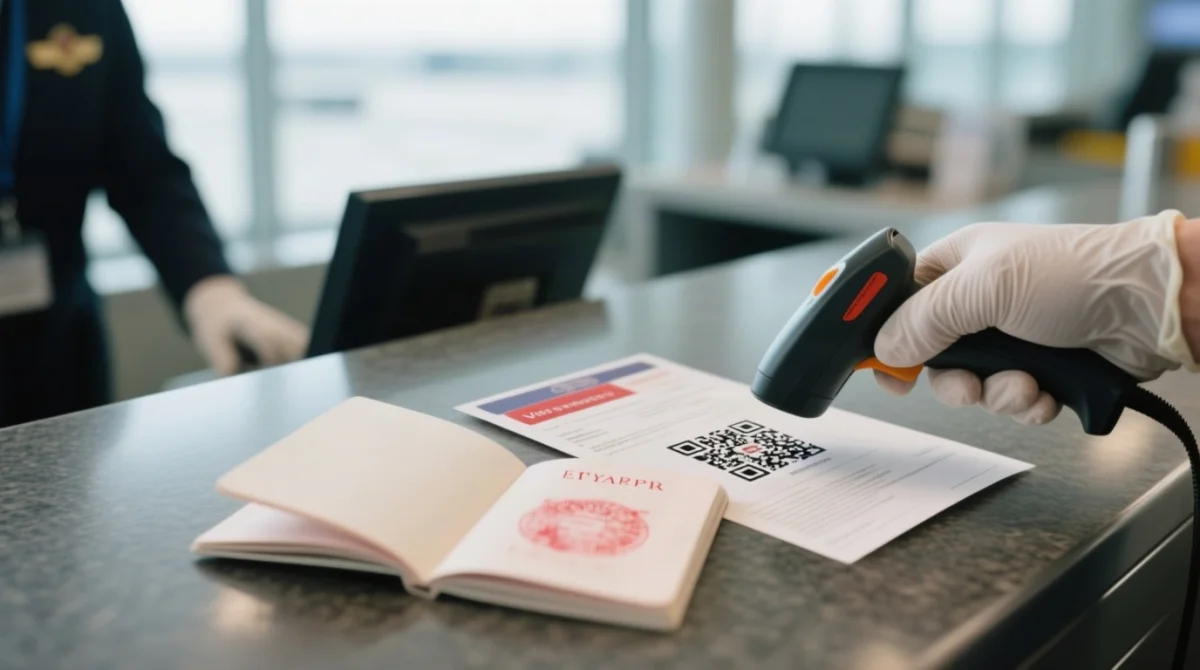
Process at Juba: disembark, proceed to the visa desk (5 minutes), get the stamp, complete biometrics, and clear customs. Below are the exact steps for this primary South Sudan eVisa port of entry. Every arriving traveller must carry a passport valid for at least 6 months after the day of arrival, containing at least 2 blank pages.
Locate the VISA desk
Find the VISA desk inside the arrival terminal.
Present your documents
Present the printed eVisa PDF alongside the valid passport.
QR code validation
Wait as the officer scans the QR code to validate the document against the immigration database.
Receive entry stamp
Receive the physical entry stamp.
Biometric data collection
Undergo biometric data collection, comprising fingerprints and facial recognition.
Baggage claim & customs
Proceed to baggage claim and customs inspection.
Power outages at land border checkpoints make printed copies mandatory; digital files fail without working screens. Always prepare physical backups for any South Sudan eVisa port of entry.
Health Screening, Customs & Vaccination Requirements
Every South Sudan eVisa port of entry mandates a Yellow Fever vaccination certificate administered at least 10 days prior to arrival. Due to the May 2026 Ebola outbreak in Uganda and Western Equatoria, land border checkpoints currently enforce strict travel history screening per Ministry of Health guidelines.
After immigration clearance at your chosen South Sudan eVisa port of entry, travellers proceed through customs. Declare cash exceeding USD 10,000 or restricted items via standard red and green channels.
Visa Options for UK Travellers: eVisa vs Embassy Visa
For UK tourists in 2026, the South Sudan eVisa (processed in 72 hours) is the fastest option compared to a visa on arrival or the £50 embassy visa in London. Securing clearance before arriving at any South Sudan eVisa port of entry prevents delays.
| Visa Type | Processing Time | Cost | Application Method |
|---|---|---|---|
| eVisa | 72 hours | Paid online (Debit card) | evisa.gov.ss |
| Visa on Arrival | On arrival | US$ 50 – US$ 100 | At a South Sudan eVisa port of entry |
| Embassy Visa (UK) | 7 working days | £50 (Single) / £100 (Multiple) | In person |
UK citizens opting for a physical sticker instead of using a South Sudan eVisa port of entry must apply directly at the UK Embassy of South Sudan.
21 Knightsbridge, London, SW1X 7LY, United KingdomPhone: +44 7404 163529
Application Hours: Mondays, Wednesdays, Fridays, 9:00 am – 12:00 pm
Collection Hours: 2:00 pm – 3:30 pm
Practical Arrival Tips: Money, Transport & Post-Arrival Rules
As of 2026, no South Sudan eVisa port of entry checkpoint or domestic business accepts credit or debit cards. Travellers should carry sufficient USD cash for all expenses. According to the South Sudan Immigration Directorate 2026 guidelines (Directive No. 12/2026), all banknotes must bear a series date of 2006 or later to be accepted for border fees.
From Juba Airport, a taxi to the city center costs $15 to $20; car rentals start at $150 per day, and local hotels reach up to $200 per night. Foreign nationals staying for five days or more past their South Sudan eVisa port of entry clearance must complete mandatory registration at a local police station. Travellers requiring an extension must apply in person at the Ministry of Interior.
Ministry of InteriorAirport Road, Juba
Phone: +211 (0)926 388 499
Email: [email protected]
South Sudan Travel Safety & FCDO Advisory (2026)
The UK FCDO advises against all travel to most of South Sudan as of 2026. Juba International Airport presents specific security risks for arriving passengers. Foreign nationals, particularly journalists or individuals with work permit irregularities, report harassment and arbitrary expulsion by local security services at this South Sudan eVisa port of entry.
Every South Sudan eVisa port of entry lacks advanced medical facilities, making comprehensive travel insurance mandatory. In severe emergencies, medical evacuation logistics dictate routing patients directly to Kampala.
FAQ: South Sudan eVisa Port of Entry
What documents do I need at a South Sudan eVisa port of entry?
You need a printed eVisa PDF, a passport valid for 6+ months with 2 blank pages, and a yellow fever vaccination certificate.
How long does the eVisa validation process take at Juba International Airport?
Validation takes about 5 minutes, which includes QR scanning, entry stamping, and biometric data collection.
Can I cross the Nimule land border with a South Sudan eVisa?
Yes, but you must carry a physical printed copy due to frequent power outages. Processing takes 30 to 90 minutes.
Is a yellow fever certificate checked at the South Sudan eVisa port of entry?
Yes, it is mandatory. Land borders also conduct Ebola travel history screening in 2026.
What happens if my eVisa is delayed before my flight?
If not approved within the standard 72 hours, you may be denied boarding or need a visa on arrival costing US$50 to US$100.
Are credit cards accepted to pay arrival taxes at Juba Airport?
No. Pay all fees in US Dollars cash using clean, untorn bills issued from 2006 onwards.
Do UK citizens need to register with the police after arriving in South Sudan?
Yes, registration at a local police station is mandatory if staying for five consecutive days or more.
How much does a South Sudan visa cost for UK citizens?
An embassy single-entry visa is £50. Visa on arrival is US$50 to US$100. The eVisa is paid online via debit card.
About the author: James Thornton is a travel security analyst who has covered East African border procedures since 2019. He holds a certificate in International Travel Health from the RSTMH.