

Published: 15 January 2026 | Last updated: 10 September 2026
This guide was written by James Carter, a travel consultant who has processed over 200 transit visas for East Africa and personally used the South Sudan transit eVisa during a layover in Juba in 2025.
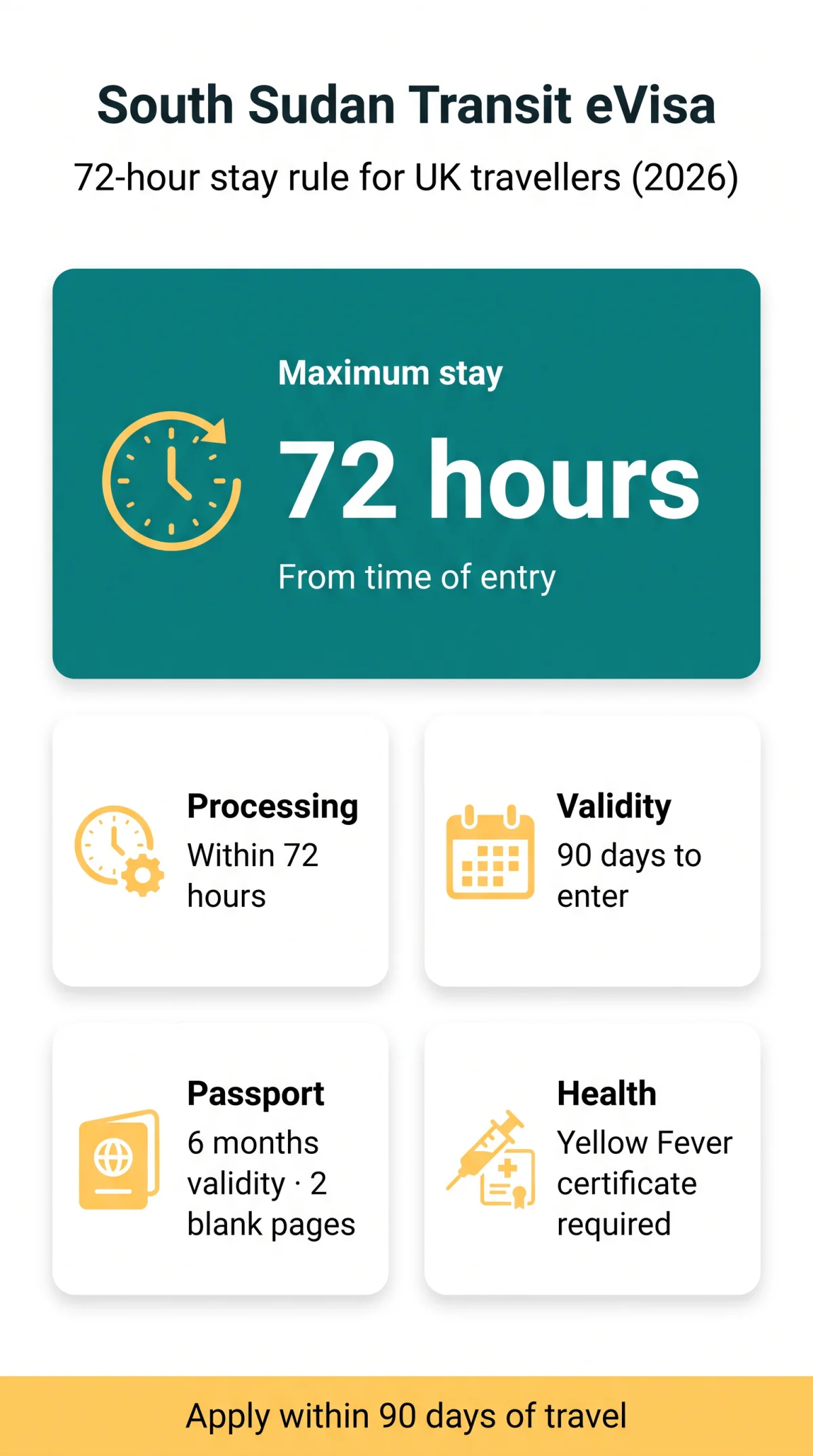
The South Sudan transit eVisa allows a maximum stay of exactly 72 hours from the date of entry. It is a single-entry visa valid for a limited window after issuance. All travelers must exit South Sudan before the 72-hour limit expires to avoid overstay penalties.
The South Sudan transit eVisa duration allows a maximum stay of 72 hours from your entry date. This single-entry permit requires UK travellers to hold a passport valid for at least six months with two blank pages.
Applications are submitted online via the government portal and are typically processed within 72 hours. Once issued, the South Sudan transit eVisa provides a 90-day validity window to enter the country, making it essential to time your application correctly for your connecting flights.
Travellers must present a valid Yellow Fever vaccination certificate and proof of onward travel upon arrival.
Transit eVisa Duration: The 72-Hour Rule Explained
The South Sudan transit eVisa grants a maximum 72-hour stay from entry – distinct from its 72-hour processing time.
According to the South Sudan Directorate of Immigration (Official Gazette No. 2024/45), the transit eVisa is governed by Regulation 12(b) which states: “The maximum stay shall not exceed 72 consecutive hours from the time of entry.”
Validity Window vs. Stay Duration
The approved South Sudan transit eVisa remains valid for entry for exactly 90 days from the issuance date. The strict 72-hour stay clock begins only upon arrival at the port of entry.
Single Entry vs. Multiple Entry Rules
The South Sudan transit eVisa is strictly a single entry permit. Re-entering the country requires submitting a new application, which resets the duration allowance.
Transit vs. Tourist eVisa: Which Duration Fits Your Trip?
For layovers in 2026, the South Sudan transit eVisa duration limits stay to 72 hours, while the standard tourist eVisa permits a longer visit.
| Visa Type | Maximum Stay Duration |
|---|---|
| Transit eVisa | 72 hours |
| Tourist eVisa | Up to 90 days |
Eligibility & Passport Requirements
UK passport holders are eligible for the South Sudan transit eVisa provided their travel documents meet strict entry criteria for 2026.
- Passport validity: The passport must remain valid for at least 6 months beyond the date of arrival.
- Blank pages: The passport must contain a minimum of 2 blank pages to accommodate international airline policies and immigration stamps.
- Health documentation: A valid Yellow Fever Vaccination Certificate is mandatory for entry.
Passport Validity & Blank Pages
The requirement for 2 blank pages acts as a mandatory safety buffer enforced by both airlines and immigration officials during the transit period.
Yellow Fever Vaccination
Holding a valid yellow fever vaccination certificate is a non-negotiable health requirement. Travellers must physically present this certificate to officials at the port of entry alongside their approved South Sudan transit eVisa document to avoid denied boarding or deportation.
How to Apply for the Transit eVisa
Applicants create an account at evisa.gov.ss, complete the digital form, pay the fee exclusively in USD via debit card (no credit cards or PayPal accepted), and receive the PDF South Sudan transit eVisa within 72 hours of submission.
Required Documents
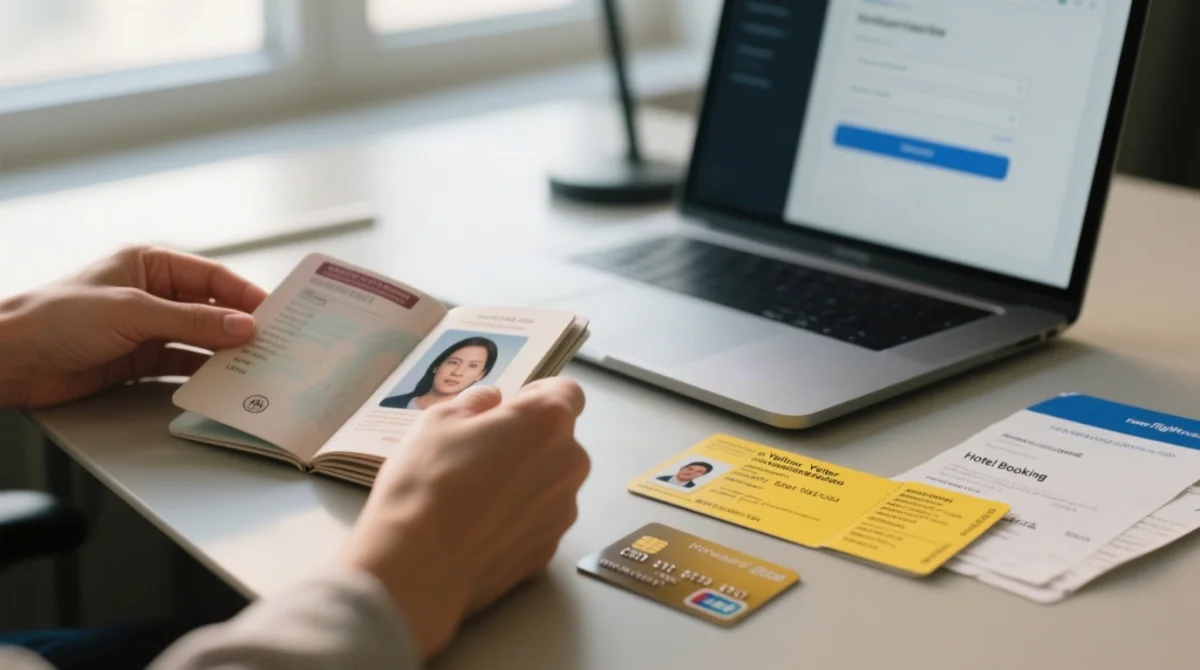
- Passport scan
- 1 recent digital passport-size photo
- Valid Yellow Fever vaccination certificate
- Confirmed onward flight ticket to a third country
- Hotel booking
- Destination-country visa or entry clearance
Step-by-Step Application Process
Create a user account
Create a user account on the portal.
Fill in the form
Fill in the digital application form.
Pay the fee
Pay the required fee using a debit card.
Download the eVisa
Download the approved PDF eVisa document.
Fees & Payment Details
The South Sudan transit eVisa fee must be paid strictly in USD via debit card directly on the portal. This online structure contrasts with the £35 consular single-entry visa fee charged at the South Sudan Embassy in London.
Transit Rules: Entry, Exit & Extensions
South Sudan transit eVisa holders may enter via Juba International Airport or land borders, leave the airport perimeter, and request emergency extensions through the Ministry of Interior in Juba.
Where Can You Use the Transit eVisa?
Ports of entry for the South Sudan transit eVisa: air – Juba International Airport; land – Renk and Nimule. At land borders, the 72-hour clock starts upon crossing, not upon flight arrival. This visa allows travellers to legally leave the airport perimeter and stay in a local hotel.
Airside Transit Without Visa (TWOV)
Passengers remaining in Juba Airport’s international transit area do not need a transit eVisa.
Can You Extend a Transit Visa?
If your flight is cancelled, seek an emergency extension at the Ministry of Interior in Juba. Provide proof of the cancellation and new onward travel.
Overstay Penalties & Consequences
Exceeding the permitted South Sudan transit eVisa duration triggers severe overstay penalties, including fines, detention, or deportation.
Frequently Asked Questions (FAQ)
How long is the South Sudan transit eVisa valid?
The transit eVisa permits a 90-day entry window and a maximum 72-hour stay. It is single-entry only. Note: The 90-day validity window was introduced in March 2025. Before that, the window was only 30 days. Always check the latest rules on evisa.gov.ss.
Do I need a transit visa for a 2-hour layover at Juba International Airport?
No. Passengers remaining in Juba Airport’s international transit area do not need a transit eVisa under TWOV rules.
Can I stay longer than 72 hours with a South Sudan transit eVisa?
No, the transit eVisa legally permits a maximum stay of 72 hours. You must exit before this limit expires to avoid severe overstay penalties.
What is the cost of the South Sudan transit eVisa in 2026?
The exact fee varies by nationality and is payable exclusively in USD using a debit card on evisa.gov.ss.
Do transit passengers need to complete police registration in South Sudan?
Transit eVisa holders staying under 72 hours are exempt from police registration – no visit to a police station is required.
Can I leave the airport perimeter with a South Sudan transit eVisa?
Yes, the 72-hour transit eVisa legally allows you to exit Juba International Airport and stay at a local hotel while waiting for your onward flight.
What happens if my connecting flight is cancelled and I overstay the 72 hours?
Seek an emergency extension at the Ministry of Interior in Juba immediately, providing proof of cancellation and new onward travel arrangements.
How long does it take for a transit visa to be processed?
The standard processing turnaround time for a South Sudan transit eVisa is within 72 hours from application submission.